
Analysis of components and problems of screw air compressor oil circuit system
author: xl
2022-12-12
Analysis of components and problems of screw air compressor oil circuit system
The oil circuit is very important in the air compression system, and many key components of the screw machine especially need lubricating oil to complete the lubricating oil to complete the bearing lubrication, system cleaning, shock absorption, sealing and conduction heat dissipation.
Screw air compressor (referred to as screw air compressor) is mainly composed of air circuit, oil circuit, control pipeline and water circuit (if it is a water-cooled model). The oil circuit is crucial in the air compressor system, and many key components of the screw machine especially need lubricating oil to complete bearing lubrication, system cleaning, shock absorption, sealing and conduction heat dissipation. Over the years, compressor mainframes have been shrinking in size, speeding faster and more integrated, pushing up internal temperatures and increasing the pressure that lubricants must withstand.
A brief understanding of the main components of the oil circuit system and the common problems related to them will help us better understand and troubleshoot the system during daily operation and maintenance. It should be noted that although the main components of the screw air compressor oil circuit system can be found on the equipment, their position in the system may be different depending on the brand, series, and model. Therefore, the content described in this article is for reference only, and the specific screw air compressor products also need to be analyzed according to the specific equipment, as the flow diagram of the air compressor system composed below, which is only used for a certain kind of equipment.
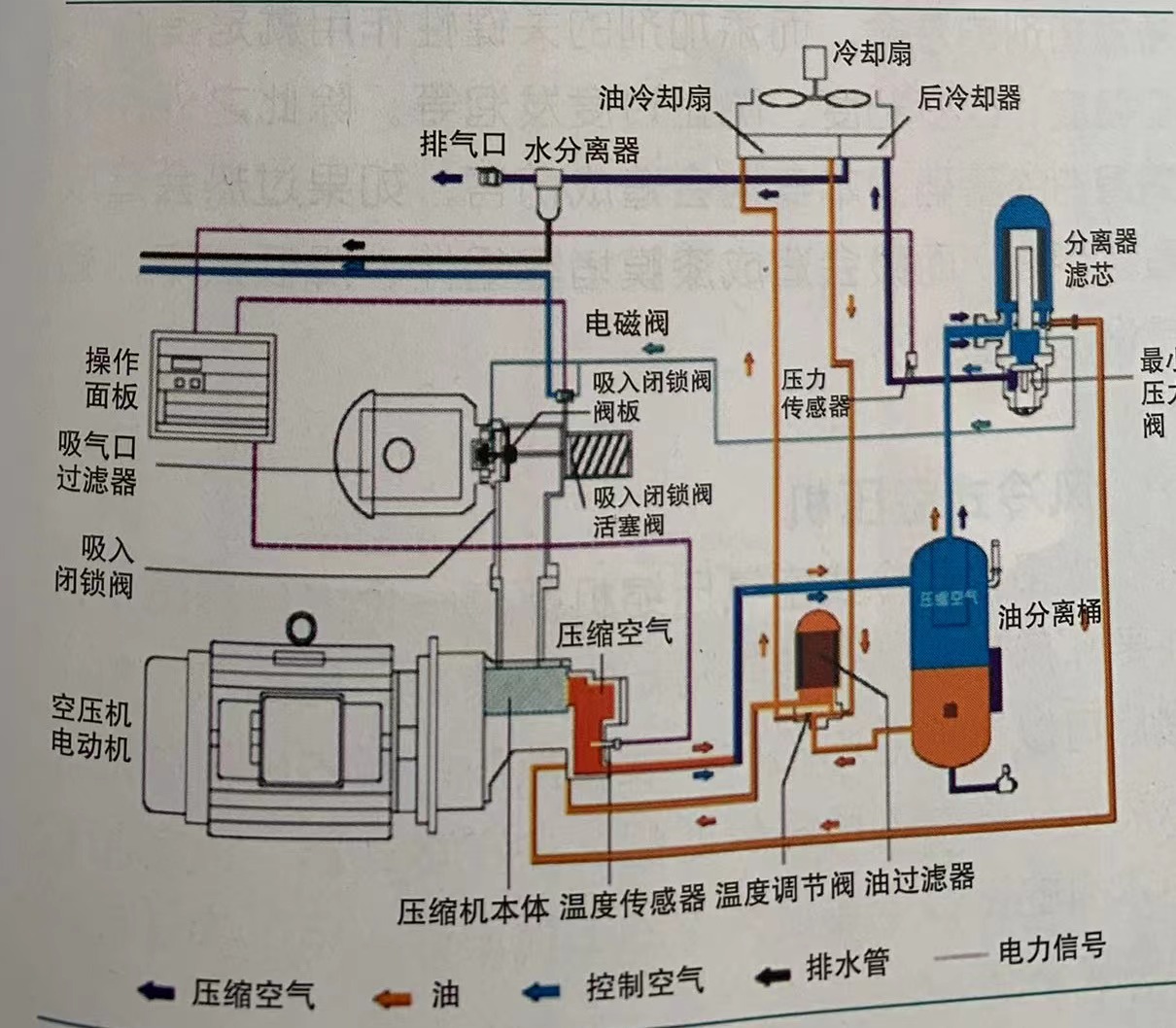
On conventional oil-injected screw air compressors, most of the lubricating oil stays in three positions when shutdown, namely the bottom of the oil and gas drum, the compressor and the oil cooler.
Oil and gas barrels
Oil and gas barrel (also known as oil separation tank) is an indispensable device of screw air compressor, which is a pressure vessel that separates the compressed oil and gas mixture, and contains an oil separation core, oil return pipe, safety valve, minimum pressure valve, pressure gauge, etc. installed on the tank. For screw air compressors, oil and gas barrels can be said to be the starting point of the oil circuit. As can be seen from the diagram, the lubricating oil is usually located in the lower part of a tank-like cylinder, which is sometimes also equipped with components for air/oil separation.
Most of the problems associated with oil and gas barrels stem from water, and if a certain amount of water accumulates in the oil and gas barrels due to the low oil temperature, or if the separation process fails to evaporate the water from the compressed air, it will continue to adversely affect lubrication for a long time. For example, it will not only cause rust and wear in the parts that need to be lubricated by the air compressor, but also cause corrosion at the bottom of the oil and gas barrel, resulting in metal particle pollution. The bottom of the barrel is usually the lower point of the entire air pressure system, so there is also a risk that pollutants or particles in the air will be absorbed, separated and accumulated at the bottom of the barrel through the inlet. If this happens, the lubricant will show a high particle count or excess metal in the oil analysis, so that even if the oil is replaced with a new oil, it will mislead the perception that something else is wrong. Since these impurities often settle at the bottom of the oil and gas drum, oil changes do not remove them very effectively. Of course, we can do maintenance by observing the moisture content analysis of the lubricating oil to ensure that excessive moisture entrainment is minimized.
Oil filter
After the air compressor is turned on, the oil and gas barrel quickly establishes pressure under the action of the minimum pressure valve and pushes the lubricating oil to start circulating. The lubricating oil at the bottom of the oil separation barrel flows through a small channel on the outside of the filter base, and under the ingenious design, it is forced to filter out impurities in the oil through the opening near the closed side of the filter housing. Lube oil filters are very effective in removing solid particles that may be sucked in from the outside atmosphere when inhaled through the air intake, and of course, the filter element can also capture iron filings and lubricating oil cokes carried by friction from the parts carried by the lubricating oil.
Many filters have a spring-loaded valve inside the population that opens to allow the oil to bypass when the lubricating oil is too thick to pass through effectively. This design of the filter has the added benefit of protecting the compressor from dry friction and high temperatures due to oil shortages when the lubricating oil temperature is low and the viscosity is high.
Therefore, the filter is a very critical maintenance item and must be replaced regularly to ensure that the bottom of the oil separation barrel is free of particulate matter. If the filter is partially or completely blocked, it can lead to a lack of lubricating oil in the system, causing serious damage to the equipment.
Temperature control valve
Temperature control valves are also known as thermostatic valves. It is well known that no matter which lubricant is used, it has an optimal operating temperature range, and over-temperature or low-temperature operation will have corresponding adverse consequences, such as the inability to establish an oil film or excessive viscosity of the oil. For screw air compressors, the temperature of lubricating oil is best between 70~85 °C. When the air compressor starts after a long time, the oil temperature is only equivalent to the ambient temperature, in order to make the air compressor start smoothly, the temperature control valve will direct the lubricating oil directly to the main engine without passing through the oil cooler. This will ensure that the oil heats up quickly to the ideal operating temperature. Once the lubricating oil reaches an acceptable operating temperature, the temperature control valve will direct the oil flow to the oil cooler to maintain that operating temperature and ensure that the oil does not overheat. Under normal circumstances, the temperature control valve is not a vulnerable component, and only in some special cases may be blocked by foreign objects that may be present in the lubricating oil. Because as you can see in the figure above, this valve is usually located behind the oil filter, and the lubricating oil flowing through it is filtered. However, the accumulated dirt caused by the lubricating oil cannot be completely eliminated, and we need to clean and maintain the valve regularly.
In addition to the lubricating oil, failure here can also be related to the valve itself. For example, the failure of the actuator of the valve, poor communication of the controller, etc. cause the valve to jam, and the lubricating oil has been kept bypassed, resulting in high temperature of the lubricating oil quickly.
Oil cooler
The exhaust temperature of the screw air compressor is too high, which will cause tripping, carbon deposits, reduced efficiency and even damage parts. One of the key measures to control the exhaust temperature of the oil-injected screw compressor is to control the temperature of the lubricating oil. Since the lubricating oil involved in the compression process is subjected to great friction during operation and withstands the temperature rise caused by the heat of compression, the lubricating oil temperature will be very high. Temperature can have many negative effects on lubricating oils, such as shortening the life of additives, whose key effects are to increase shear strength, change viscosity, and prevent excessive foaming. In addition, the base oil itself will also cause damage to the lubricating oil, if overheating will cause the acidity to become high, and the acid will cause the paint film to clog the components, reduce efficiency, and cause serious damage to the equipment.
Air-cooled air compressor
Most air-cooled air compressors have a large displacement fan whose main role is to remove a lot of heat from the lubricating oil. In contrast to water coolers, fans dissipate heat from all components in a cabinet, not just the heat sink. An excellent air-cooler match involves extensive engineering in the design of the cooler, fan and cabinet itself to ensure optimal airflow to dissipate heat.
What our maintenance personnel have to do is to clean and maintain these coolers regularly to ensure heat dissipation. The outer surface of the cooler of an air-cooled air compressor is often reduced due to the accumulation of excessive dust or other debris, resulting in a decrease in the heat transfer effect, resulting in an increase in oil temperature. Simply purging the cooler to remove the accumulated dust can have a huge impact on the operating temperature of the air compressor. In addition, sludge will accumulate on the cooler pipe wall, insulating the lubricating oil from the inner wall of the cooler, resulting in poor heat dissipation, which usually requires special cleaning agents for cleaning.
Water-cooled air compressor
According to GB 50029-2014 "Compressed Air Station Design Code" 7.0.4 air compressor and its cooler cooling water quality standard, should comply with the current national standard "Industrial Circulating Cooling Water Treatment Design Code" GB50050 relevant provisions. In order to save investment, many enterprises often directly use tap water or other process circulating water as the cooling water of the air compressor, and the concentration of calcium and magnesium ions in the water increases after long-term use, forming scale, resulting in poor heat dissipation effect. Another common problem is the cooling water temperature, which may be too low, resulting in increased condensation in the compressed air; Or the temperature is not low enough, resulting in a high oil temperature. In addition, the cooling water pressure is low, which may be that the concentration of suspended particles in the circulating water exceeds the standard, resulting in the filter screen on the inlet pipeline filter being blocked.
Oil shut-off valve
Generally speaking, the air compressor oil shut-off valve is installed at the lower end of the exhaust port of the air compressor main engine. After the air compressor is turned on, the oil shut-off valve opens, and the lubricating oil through the oil filter enters the main engine; When the air compressor is stopped, the oil shut-off valve closes and cuts off the oil supply. The oil shut-off valve is mainly used to control the main oil circuit into the head of the air compressor a switch, cut off the oil supply to the host when the air compressor is stopped, avoid the lubricating oil spray from the main engine port, and prevent the situation of oil backflow at the moment of shutdown. Without this valve, the main engine may run at very low pressure or completely run out of lubricating oil, or the oil may flow backstream when pressure is lost.
Air/oil separator
The air is compressed by the compressor main engine to expel a mixture of air, oil and water at extremely high temperatures, and then it is necessary to separate the compressed air products that can be used downstream, while the lubricating oil is recycled into the oil and gas barrels, and the water vapor and liquid water generated in the compressed air are removed, a complex task performed by the air/oil separator.
The oil-air mixture generally rotates outside the separator, and most of the lubricating oil can be separated by centrifugal effect, dripping into the cylinder and back to the bottom under gravity, while the compressed air is discharged from the upper part of the separator. The lubricant will start the next cycle.
Air compressor host
In fact, one of the core nodes of the oil circuit is the head of the air compressor. In this link, the high-speed rotating rotor will be wrapped in the lubricating oil sprayed into the cavity, forming a thin oil film between the rotor and the shell to prevent direct contact between the yin and yang rotor, rotor and housing. The lubricating oil acquires extremely high temperatures during this process, which relieves this extreme heat from the rotor and bearings by carrying the temperature out and away from the main engine. Lubricants need to be very close to the design viscosity or thickness to effectively achieve their intended purpose. If the oil film is too thick, it may not be able to transfer heat fast enough, which will cause high temperatures in the main engine. If the oil film is too thin or the oil amount is insufficient due to insufficient oil pressure, it will cause metal friction damage and high temperature of the machine head, and severe cases may cause the machine head to lock.
The oil circuit is very important in the air compression system, and many key components of the screw machine especially need lubricating oil to complete the lubricating oil to complete the bearing lubrication, system cleaning, shock absorption, sealing and conduction heat dissipation.
Screw air compressor (referred to as screw air compressor) is mainly composed of air circuit, oil circuit, control pipeline and water circuit (if it is a water-cooled model). The oil circuit is crucial in the air compressor system, and many key components of the screw machine especially need lubricating oil to complete bearing lubrication, system cleaning, shock absorption, sealing and conduction heat dissipation. Over the years, compressor mainframes have been shrinking in size, speeding faster and more integrated, pushing up internal temperatures and increasing the pressure that lubricants must withstand.
A brief understanding of the main components of the oil circuit system and the common problems related to them will help us better understand and troubleshoot the system during daily operation and maintenance. It should be noted that although the main components of the screw air compressor oil circuit system can be found on the equipment, their position in the system may be different depending on the brand, series, and model. Therefore, the content described in this article is for reference only, and the specific screw air compressor products also need to be analyzed according to the specific equipment, as the flow diagram of the air compressor system composed below, which is only used for a certain kind of equipment.
On conventional oil-injected screw air compressors, most of the lubricating oil stays in three positions when shutdown, namely the bottom of the oil and gas drum, the compressor and the oil cooler.
Oil and gas barrels
Oil and gas barrel (also known as oil separation tank) is an indispensable device of screw air compressor, which is a pressure vessel that separates the compressed oil and gas mixture, and contains an oil separation core, oil return pipe, safety valve, minimum pressure valve, pressure gauge, etc. installed on the tank. For screw air compressors, oil and gas barrels can be said to be the starting point of the oil circuit. As can be seen from the diagram, the lubricating oil is usually located in the lower part of a tank-like cylinder, which is sometimes also equipped with components for air/oil separation.
Most of the problems associated with oil and gas barrels stem from water, and if a certain amount of water accumulates in the oil and gas barrels due to the low oil temperature, or if the separation process fails to evaporate the water from the compressed air, it will continue to adversely affect lubrication for a long time. For example, it will not only cause rust and wear in the parts that need to be lubricated by the air compressor, but also cause corrosion at the bottom of the oil and gas barrel, resulting in metal particle pollution. The bottom of the barrel is usually the lower point of the entire air pressure system, so there is also a risk that pollutants or particles in the air will be absorbed, separated and accumulated at the bottom of the barrel through the inlet. If this happens, the lubricant will show a high particle count or excess metal in the oil analysis, so that even if the oil is replaced with a new oil, it will mislead the perception that something else is wrong. Since these impurities often settle at the bottom of the oil and gas drum, oil changes do not remove them very effectively. Of course, we can do maintenance by observing the moisture content analysis of the lubricating oil to ensure that excessive moisture entrainment is minimized.
Oil filter
After the air compressor is turned on, the oil and gas barrel quickly establishes pressure under the action of the minimum pressure valve and pushes the lubricating oil to start circulating. The lubricating oil at the bottom of the oil separation barrel flows through a small channel on the outside of the filter base, and under the ingenious design, it is forced to filter out impurities in the oil through the opening near the closed side of the filter housing. Lube oil filters are very effective in removing solid particles that may be sucked in from the outside atmosphere when inhaled through the air intake, and of course, the filter element can also capture iron filings and lubricating oil cokes carried by friction from the parts carried by the lubricating oil.
Many filters have a spring-loaded valve inside the population that opens to allow the oil to bypass when the lubricating oil is too thick to pass through effectively. This design of the filter has the added benefit of protecting the compressor from dry friction and high temperatures due to oil shortages when the lubricating oil temperature is low and the viscosity is high.
Therefore, the filter is a very critical maintenance item and must be replaced regularly to ensure that the bottom of the oil separation barrel is free of particulate matter. If the filter is partially or completely blocked, it can lead to a lack of lubricating oil in the system, causing serious damage to the equipment.
Temperature control valve
Temperature control valves are also known as thermostatic valves. It is well known that no matter which lubricant is used, it has an optimal operating temperature range, and over-temperature or low-temperature operation will have corresponding adverse consequences, such as the inability to establish an oil film or excessive viscosity of the oil. For screw air compressors, the temperature of lubricating oil is best between 70~85 °C. When the air compressor starts after a long time, the oil temperature is only equivalent to the ambient temperature, in order to make the air compressor start smoothly, the temperature control valve will direct the lubricating oil directly to the main engine without passing through the oil cooler. This will ensure that the oil heats up quickly to the ideal operating temperature. Once the lubricating oil reaches an acceptable operating temperature, the temperature control valve will direct the oil flow to the oil cooler to maintain that operating temperature and ensure that the oil does not overheat. Under normal circumstances, the temperature control valve is not a vulnerable component, and only in some special cases may be blocked by foreign objects that may be present in the lubricating oil. Because as you can see in the figure above, this valve is usually located behind the oil filter, and the lubricating oil flowing through it is filtered. However, the accumulated dirt caused by the lubricating oil cannot be completely eliminated, and we need to clean and maintain the valve regularly.
In addition to the lubricating oil, failure here can also be related to the valve itself. For example, the failure of the actuator of the valve, poor communication of the controller, etc. cause the valve to jam, and the lubricating oil has been kept bypassed, resulting in high temperature of the lubricating oil quickly.
Oil cooler
The exhaust temperature of the screw air compressor is too high, which will cause tripping, carbon deposits, reduced efficiency and even damage parts. One of the key measures to control the exhaust temperature of the oil-injected screw compressor is to control the temperature of the lubricating oil. Since the lubricating oil involved in the compression process is subjected to great friction during operation and withstands the temperature rise caused by the heat of compression, the lubricating oil temperature will be very high. Temperature can have many negative effects on lubricating oils, such as shortening the life of additives, whose key effects are to increase shear strength, change viscosity, and prevent excessive foaming. In addition, the base oil itself will also cause damage to the lubricating oil, if overheating will cause the acidity to become high, and the acid will cause the paint film to clog the components, reduce efficiency, and cause serious damage to the equipment.
Air-cooled air compressor
Most air-cooled air compressors have a large displacement fan whose main role is to remove a lot of heat from the lubricating oil. In contrast to water coolers, fans dissipate heat from all components in a cabinet, not just the heat sink. An excellent air-cooler match involves extensive engineering in the design of the cooler, fan and cabinet itself to ensure optimal airflow to dissipate heat.
What our maintenance personnel have to do is to clean and maintain these coolers regularly to ensure heat dissipation. The outer surface of the cooler of an air-cooled air compressor is often reduced due to the accumulation of excessive dust or other debris, resulting in a decrease in the heat transfer effect, resulting in an increase in oil temperature. Simply purging the cooler to remove the accumulated dust can have a huge impact on the operating temperature of the air compressor. In addition, sludge will accumulate on the cooler pipe wall, insulating the lubricating oil from the inner wall of the cooler, resulting in poor heat dissipation, which usually requires special cleaning agents for cleaning.
Water-cooled air compressor
According to GB 50029-2014 "Compressed Air Station Design Code" 7.0.4 air compressor and its cooler cooling water quality standard, should comply with the current national standard "Industrial Circulating Cooling Water Treatment Design Code" GB50050 relevant provisions. In order to save investment, many enterprises often directly use tap water or other process circulating water as the cooling water of the air compressor, and the concentration of calcium and magnesium ions in the water increases after long-term use, forming scale, resulting in poor heat dissipation effect. Another common problem is the cooling water temperature, which may be too low, resulting in increased condensation in the compressed air; Or the temperature is not low enough, resulting in a high oil temperature. In addition, the cooling water pressure is low, which may be that the concentration of suspended particles in the circulating water exceeds the standard, resulting in the filter screen on the inlet pipeline filter being blocked.
Oil shut-off valve
Generally speaking, the air compressor oil shut-off valve is installed at the lower end of the exhaust port of the air compressor main engine. After the air compressor is turned on, the oil shut-off valve opens, and the lubricating oil through the oil filter enters the main engine; When the air compressor is stopped, the oil shut-off valve closes and cuts off the oil supply. The oil shut-off valve is mainly used to control the main oil circuit into the head of the air compressor a switch, cut off the oil supply to the host when the air compressor is stopped, avoid the lubricating oil spray from the main engine port, and prevent the situation of oil backflow at the moment of shutdown. Without this valve, the main engine may run at very low pressure or completely run out of lubricating oil, or the oil may flow backstream when pressure is lost.
Air/oil separator
The air is compressed by the compressor main engine to expel a mixture of air, oil and water at extremely high temperatures, and then it is necessary to separate the compressed air products that can be used downstream, while the lubricating oil is recycled into the oil and gas barrels, and the water vapor and liquid water generated in the compressed air are removed, a complex task performed by the air/oil separator.
The oil-air mixture generally rotates outside the separator, and most of the lubricating oil can be separated by centrifugal effect, dripping into the cylinder and back to the bottom under gravity, while the compressed air is discharged from the upper part of the separator. The lubricant will start the next cycle.
Air compressor host
In fact, one of the core nodes of the oil circuit is the head of the air compressor. In this link, the high-speed rotating rotor will be wrapped in the lubricating oil sprayed into the cavity, forming a thin oil film between the rotor and the shell to prevent direct contact between the yin and yang rotor, rotor and housing. The lubricating oil acquires extremely high temperatures during this process, which relieves this extreme heat from the rotor and bearings by carrying the temperature out and away from the main engine. Lubricants need to be very close to the design viscosity or thickness to effectively achieve their intended purpose. If the oil film is too thick, it may not be able to transfer heat fast enough, which will cause high temperatures in the main engine. If the oil film is too thin or the oil amount is insufficient due to insufficient oil pressure, it will cause metal friction damage and high temperature of the machine head, and severe cases may cause the machine head to lock.
Dongguan industry seminar
Related Article

In2020, under the premise of ensuring the safety of epidemic prevention, Jinyuan arranged for two of our drawing engineers to attend the Dongguan industry seminar to discuss a technology.
Dongguan industry seminar

From November to December 2021, many air compressor brand owners came to the Dongguan exhibition to carry out.
Dongguan multi Industry Exhibition
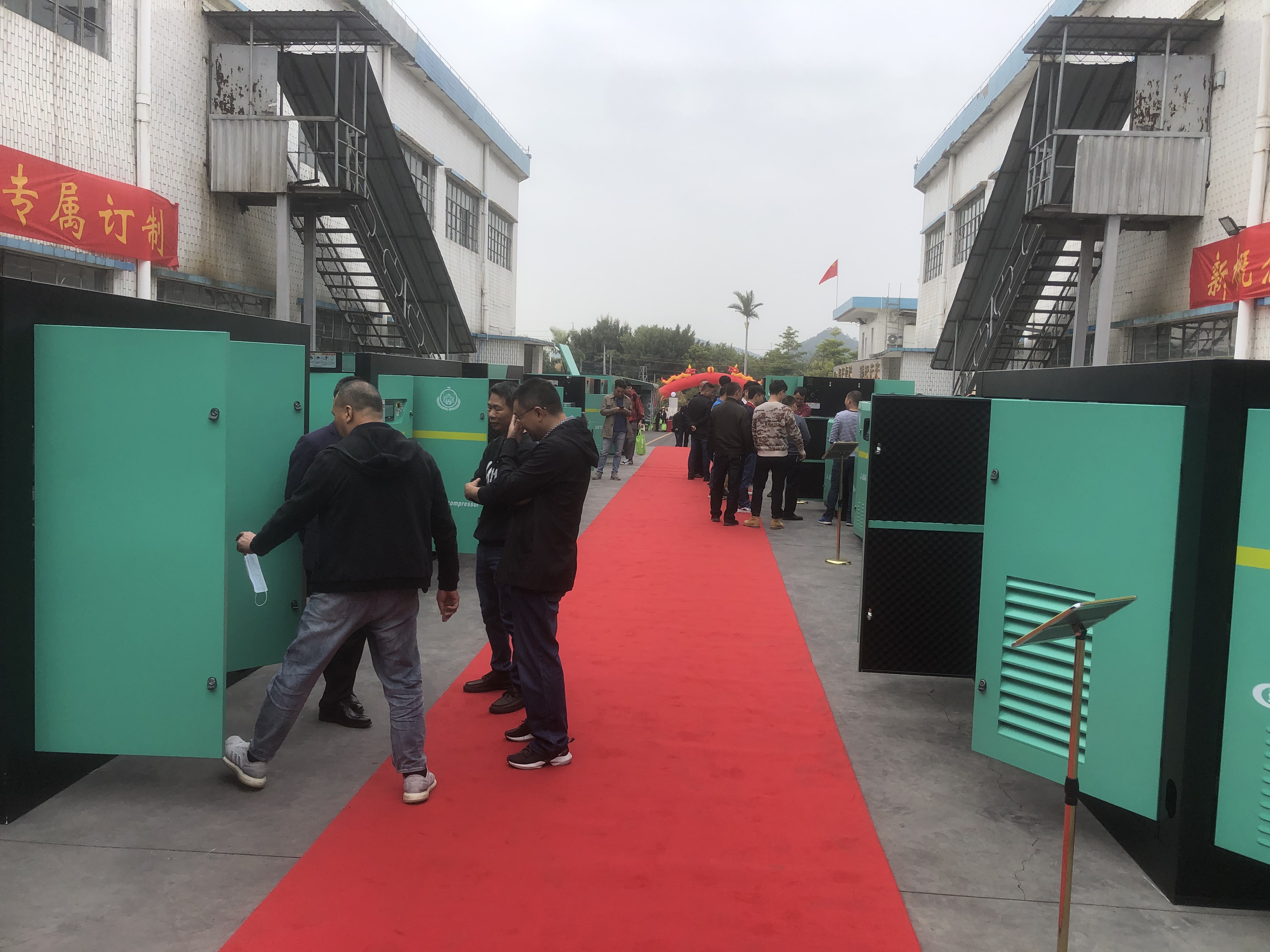
In December 2020, we carried out a series of small exhibition of air compressors hosted by Jinyuan, which is fully prepared to deal with the problems of guests. We hope to let you know our corporate culture, enterprise spirit, team strength and other aspects of the strength of Jinyuan.
Small exhibition in December 2022